- Repairology
My brother Ralph bought a car used from a dealer. It had been repaired after a collision, but the repair was not evident. He uses the car for commuting. It had a new bumper fascia put on it as part of the repair but the fascia was painted without first applying a bonding agent to the plastic.. The fascia is the soft part of the bumper. The paint is peeling off of it. For someone wanting a neat car, this car has become grungy.
Last year a construction “barrel” ( I one of those orange and white stripped affairs designed to damage cars in construction zones), blew in front of the car on the highway. Ralph did not report it or file an insurance claim. It would have been a hassle and life is busy. The barrel ripped the fascia. He now thinks that maybe he should have filed a claim. So it goes.
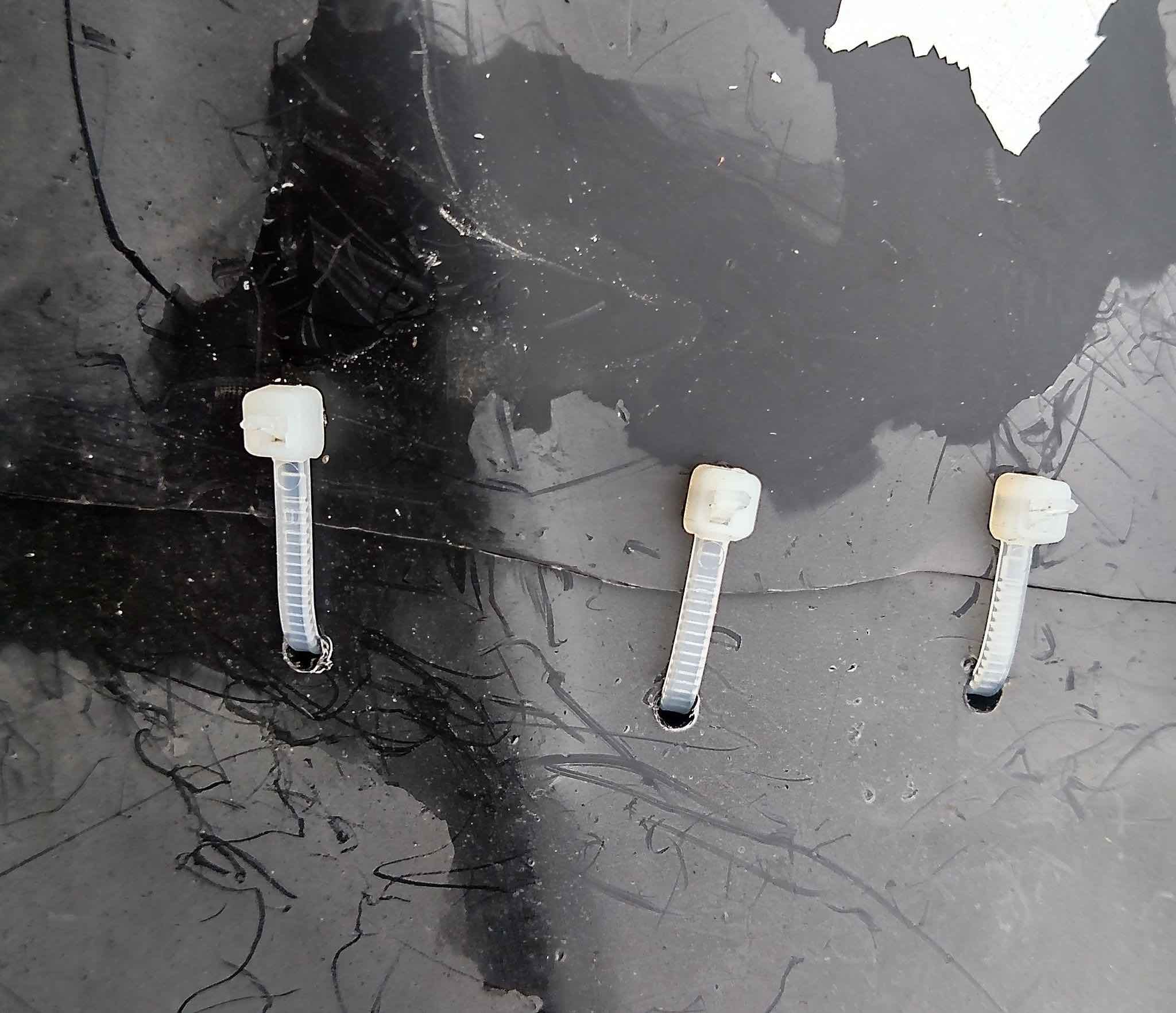
A few days ago he drilled some holes on either side of the tear in the bumper fascia and connected the two sides together with plastic cable ties. The cable ties are white. The fascia without the paint is black. According to Ralph, ” the cable ties are what I had”. This got me thinking of repairs, how they are made, and why they are made, and how they are perceived. Right now the categorization slicing instrument in my brain is slicing “repair” into five different kinds.
Coverup. (also known by the name “Buyer Beware Repair” or repair by gonif גנב)
This is the kind of repair that is not supposed to be seen. Cars are often fixed after collisions so that you cannot see the repair. The same brother had the case of repair that he did not see and he bought a different car with damage. In Thailand 30 years ago we saw cracked water jars being skillfully repaired in the city of Ratchaburi with cement and then covered with skillful trompe l’oeil painting. These repairs cover a perhaps functionally deficient product so that it looks undamaged. If you are tuned in to the idea of ” buyer beware” then this sort of covering up of defects is acceptable. If you believe that the seller should point out faults in a product then they are not acceptable repairs, unless we are first told of them.
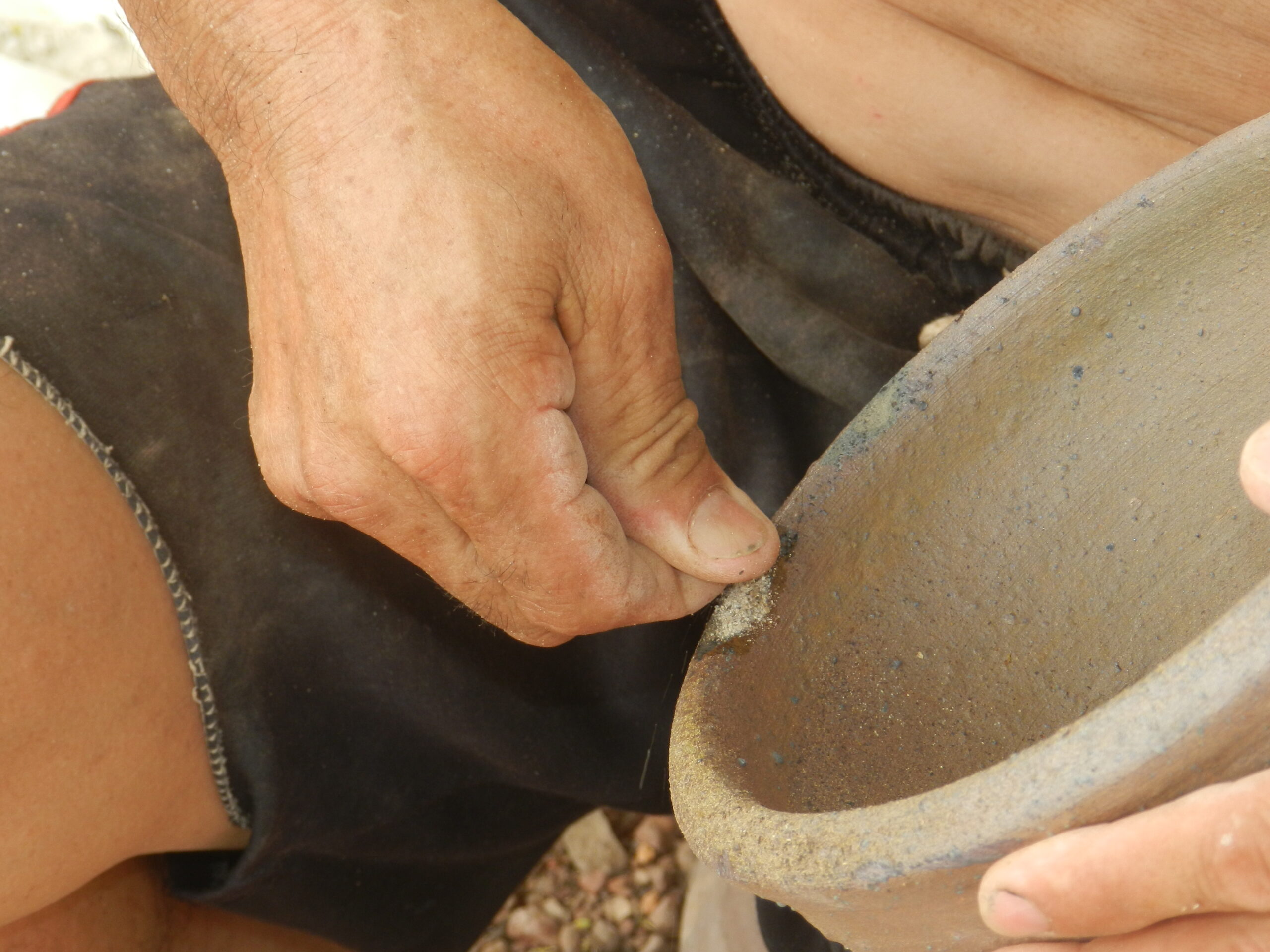
Dis-appearance: In Phon Bok Thailand Stoneware mortars that have chips or surface details that are not perfect have them covered up with super glue covered with ashes. These repairs cover only cosmetic “flaws” that would lower the price because of appearances. Mortars that have functional defects are used for landfill, to make decorative walls, they are not sold. The mortars have to take a lot of abuse and are not expensive. If damaged they are not worth the hassle. Even the makers do not try to cover up functional defects. This would lower the value of their products.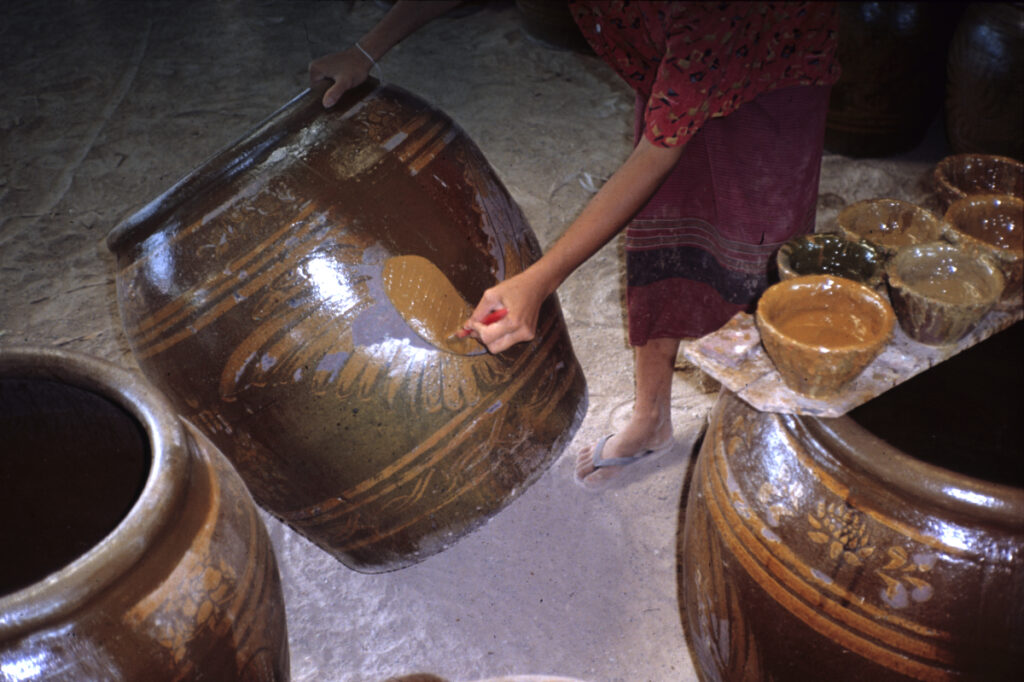
Ratchaburi Jar being painted (1989)
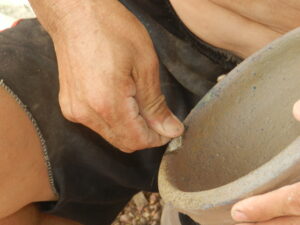
Cosmetic repair in Phon Bok
Just Repair: This is just a repair. No, or little consideration is made concerning the repair. It is just repaired. Nothing is covered up or concealed. This is the kind of repair that is held in high regard by Soetsu Yanagi when discussing Korean wooden bowls. It has a stance of honesty, of thusness, it is what it is. The bowls are turned from green wood. When they crack, they are repaired. This is what my brother did. He repaired his bumper with available cable ties. No cover up, no intent to do anything but make it functional.
Intentious Repair: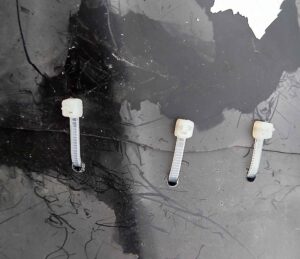
Bumper fascia repaired with cable ties (photo credit Ralph Katz)
This is a Just Repair specifically made with the intent of looking like a just repair. Pretentiously, rather than just making the repair, the intent is to make it look like you did not care about appearances. You not only might not care, you want others to know that you don’t. Louis does these. The picture of a bumper posted to the web by a sophisticated artist, even if the art is music, makes me wonder if Ralph’s qualifies as intentious. I have not asked. Either way it has sparked my interest. I have appreciated it. The bumper, at least in my mind is interesting. Appreciated it enriches life. Appreciation appreciates the value of an object or event.
I have shirts that I bought in 1989 in Thailand. In Thai the name of the shirts seems to be “humble shirts”. I wore mine every wash until they got fairly worn. Others would say “worn out”, but I prefer “broken in”. After that I wore them on non-school days. My personal feeling is that these shirts still have use with a little repair, and that long use is as functional, maybe more functional than recycling. So I have repaired these shirts. They are repaired rather funkily, wow spell check has “funkily”! The repairs are so obvious and perhaps overdone that they might go beyond intentious into the next category, The Conspicuous Elevation of Repair Repair.
Conspicuous Elevated Repair, Kintsugi.
Kintsugi is a Japanese repair technique often used on ceramics using urishi lacquer, a natural resin. It is water proof and holds up to mild heat. The repair resin, made from the sap of the urishi tree, is sometimes filled with iron oxide, but the upper layers are often instead filled or surfaced with gold powder. This makes the repair, a record of the objects history and its breaking, obvious. It makes the damage obvious, making it impossible to ignore. It holds, displays, asserts that use becomes tangible part of an object. In highlighting use and wear it elevated repair seems to demand that bowls are drunk from and not just displayed that you know it and that you remember.
Rather than coverup, rather than mourning the inevitable, kitsugi is an affirmative joyful appreciation of the mutual arising of creation and destruction, afe, wear and tear, and eventual breaking of ceramics. The atmospheric firing of ceramics leaves a trace of its time in the kiln, the repair is just another page in the history of the work. Art is often made in a way the reveals the process of making. With tea ware in Japan there is recognition that who has drunk tea from a bowl, how it is stored, and in what manner it is handled becomes a part of the work. So does the wear and repair. Raku, a firing technique, and shino, a type of glaze both leave a surface with a fine network of cracks. This allows tea to stain the cracks and sometimes the clay body, overtime changing the appearance and making it appear worn before there really is any wear.
While most of the Japanese aesthetics surrounding tea ware stresses a quiet understated natural feel, Kintsugi seems almost diametrically opposed to this. . The contrast creates a sense of importance of the issues surrounding the repair .The gold, bright, valuable, associated with the aristocracy, seems wildly antithetical to the humble nature works that are repaired. On its visual soapbox, kitsugi loudly speaks, “I am a repair” . It is an unassailable statement affirming use and wear as an aspect of an object and aesthetics. If you don’t understand this, the gold slaps you in the face with the message.
(Look up boro repair and shashiko Japanese clothing repair)
But all of these repair techniques, and their associated intent are in some ways the same. Each tells a story, each leaves an impression of intent, or lack of it. Each expresses an attitude on the topic of mutual arising. Each tells of human nature. The difference is in the way we perceive and the way we appreciate them, and in our understanding of the intent of the person who repaired it. The difference, for the most part resides in the viewer. It is the viewer that appreciates, the creates the great value of the repair.
Non Repair repair
This is repair after intentionally breaking an object, or making an object specifically to look as if it is repaired. Goro Suzuki, whose work is purposefully broken is the master of the Non Repair repair. He intentionally breaks pieces to repair them, and really builds his work with kintsugi type repair techniques. For him it does not need to be broken to repair it. Its like he is saying, “If its not broken fix it anyways.” I am not sure that there is anything as conspicuous as this kind of “repair”. The fact that it is not broken screams for its own category . The function of the Non Repair repair is often to teach appreciation of repair.
The place where repair has become more a part of the aesthetic culture than elsewhere is Japan. But modern Japan is quite a throw away society. Houses get too old, cars get too old, clothes have to look new and respectable, hair is always highly tamed. But in this atmosphere kintsugi and the boro technique and shashiko clothing repair seem a response to this, a cultural self criticism. Not being Japanese it is hard to know.
The appreciation of the worn, the repaired, the aged, the imperfect, while it seems far from modern Japanese day to day life, is part of the cultural aesthetic. But it also appears elsewhere. New blue jeans in the US can almost be embarassing in youth culture. This is so true that new jeans are often bleached, stone washed and intentionally distressed in other ways before being sold. Some of the coolest “hippy” clothing were blue jean skirts sewn out of multiple pairs of worn out blue jean pants.
I often think of a bunch of poles or nodes pulling at the creation of worn jeans. - The Pragmatism Node and being a cheapskate. This is also tied to just being poor and not being able to afford or wanting to afford new cloths. Likely need and want could be separated out into separate nodes. There is overlap here with other nodes.
- Appreciation of the look, the Wabi connoisseur.
- Marketability, the Stone Washed Node
- concern for the environmental impact of cotton and consumerism, the Green Node
- the Clueless Node. This is the node of people for whom the buying of new clothes is just a distraction from the rest of their lives, they don’t notice.
These nodes are just like little elastic straps that pull on how we deal with our jeans or other objects. My old denim-type clothing is clearly elastically attached to each of these nodes.
Certainly I am not the first in my interest in such things. But the earliest serious interest, and just about the only significant historical cultural manifestation that I know about was the period surround what Louise Cort calls “The Teabowl Wars” and the moves in Japan from the aesthetic of glitzy teaware to wabi and move from connoisseurship of folk pottery to the purposefully making of wabi imbued wares.
Relation to teaware’s shift from being curated from folk pots to purposefully made to be “funky”