Category Archives: Dear Louise
Repairology
- Repairology
My brother Ralph bought a car used from a dealer. It had been repaired after a collision, but the repair was not evident. He uses the car for commuting. It had a new bumper fascia put on it as part of the repair but the fascia was painted without first applying a bonding agent to the plastic.. The fascia is the soft part of the bumper. The paint is peeling off of it. For someone wanting a neat car, this car has become grungy.
Last year a construction “barrel” ( I one of those orange and white stripped affairs designed to damage cars in construction zones), blew in front of the car on the highway. Ralph did not report it or file an insurance claim. It would have been a hassle and life is busy. The barrel ripped the fascia. He now thinks that maybe he should have filed a claim. So it goes.
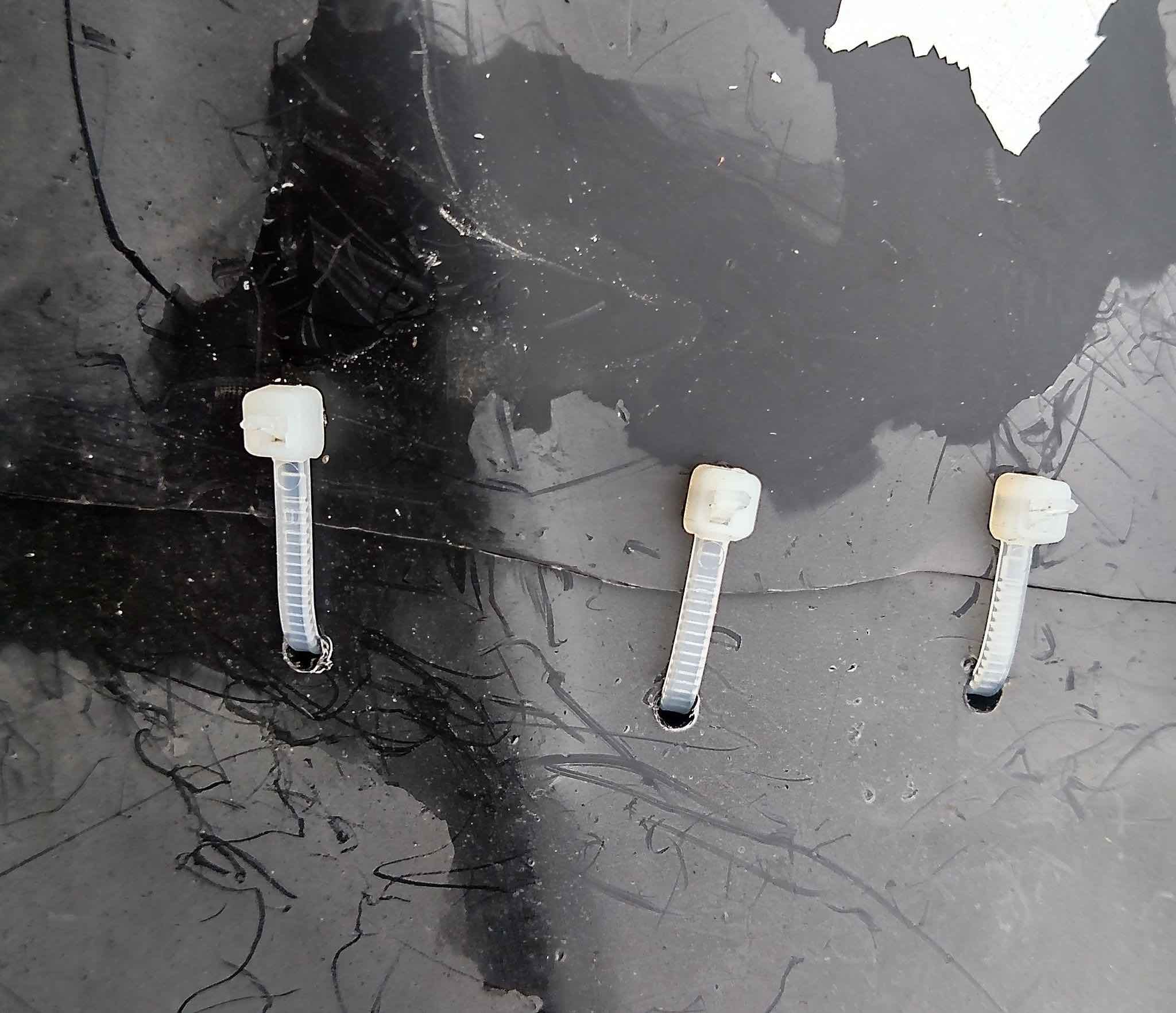
A few days ago he drilled some holes on either side of the tear in the bumper fascia and connected the two sides together with plastic cable ties. The cable ties are white. The fascia without the paint is black. According to Ralph, ” the cable ties are what I had”. This got me thinking of repairs, how they are made, and why they are made, and how they are perceived. Right now the categorization slicing instrument in my brain is slicing “repair” into five different kinds.
Coverup. (also known by the name “Buyer Beware Repair” or repair by gonif גנב)
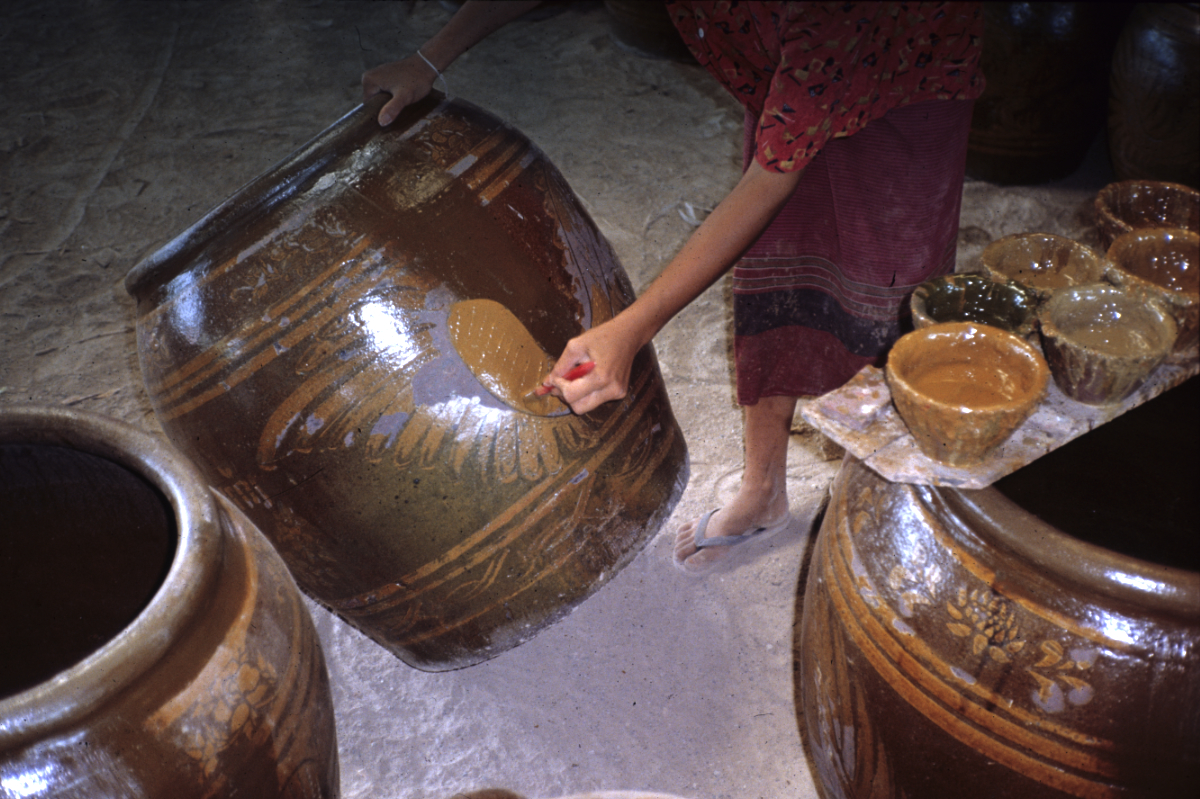
This is the kind of repair that is not supposed to be seen. Cars are often fixed after collisions so that you cannot see the repair. The same brother had the case of repair that he did not see and he bought a different car with damage. In Thailand 30 years ago we saw cracked water jars being skillfully repaired in the city of Ratchaburi with cement and then covered with skillful trompe l’oeil painting. These repairs cover a perhaps functionally deficient product so that it looks undamaged. If you are tuned in to the idea of ” buyer beware” then this sort of covering up of defects is acceptable. If you believe that the seller should point out faults in a product then they are not acceptable repairs, unless we are first told of them.
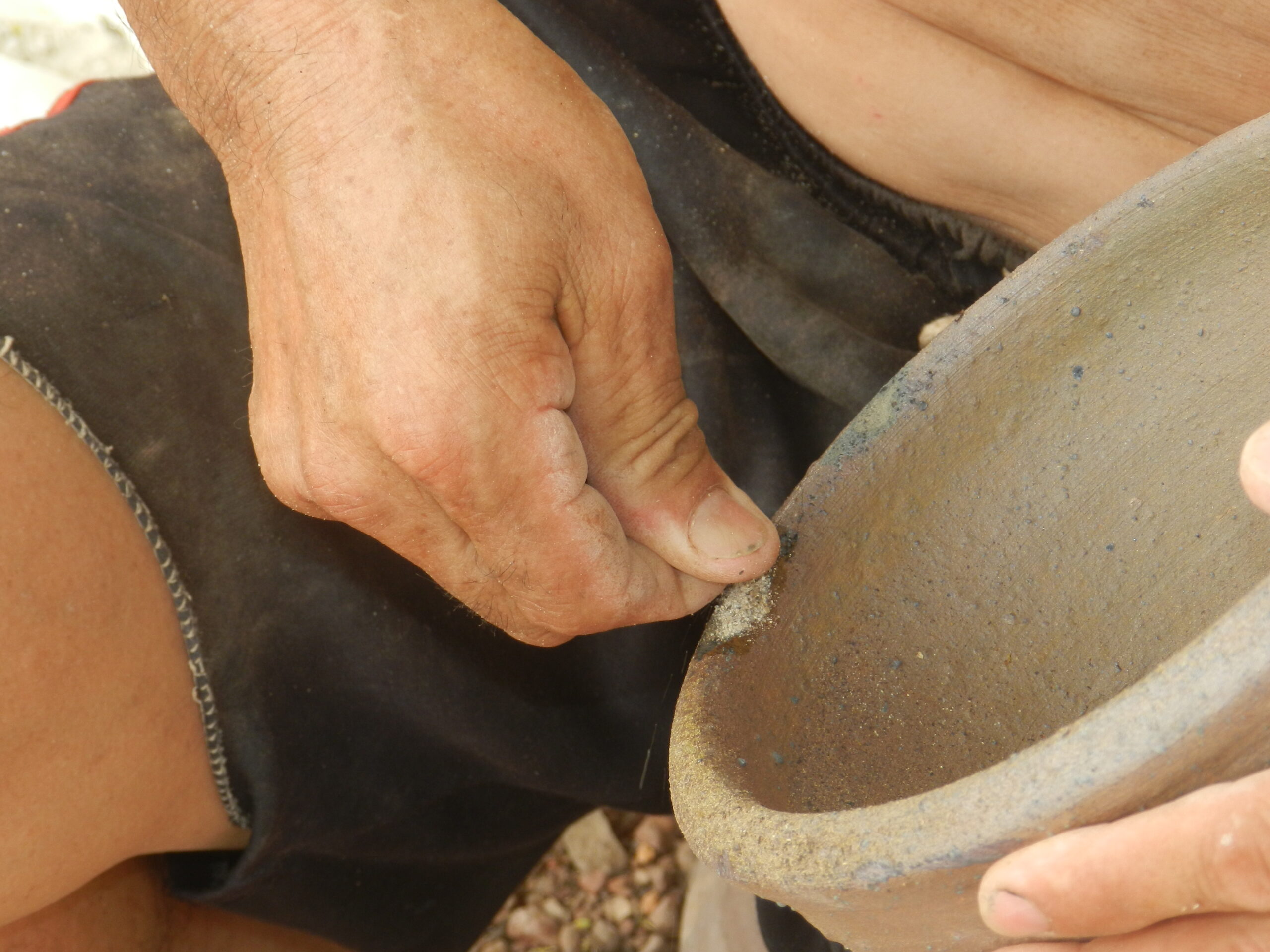
Dis-appearance: In Phon Bok Thailand Stoneware mortars that have chips or surface details that are not perfect have them covered up with super glue covered with ashes. These repairs cover only cosmetic “flaws” that would lower the price because of appearances. Mortars that have functional defects are used for landfill, to make decorative walls, they are not sold. The mortars have to take a lot of abuse and are not expensive. If damaged they are not worth the hassle. Even the makers do not try to cover up functional defects. This would lower the value of their products.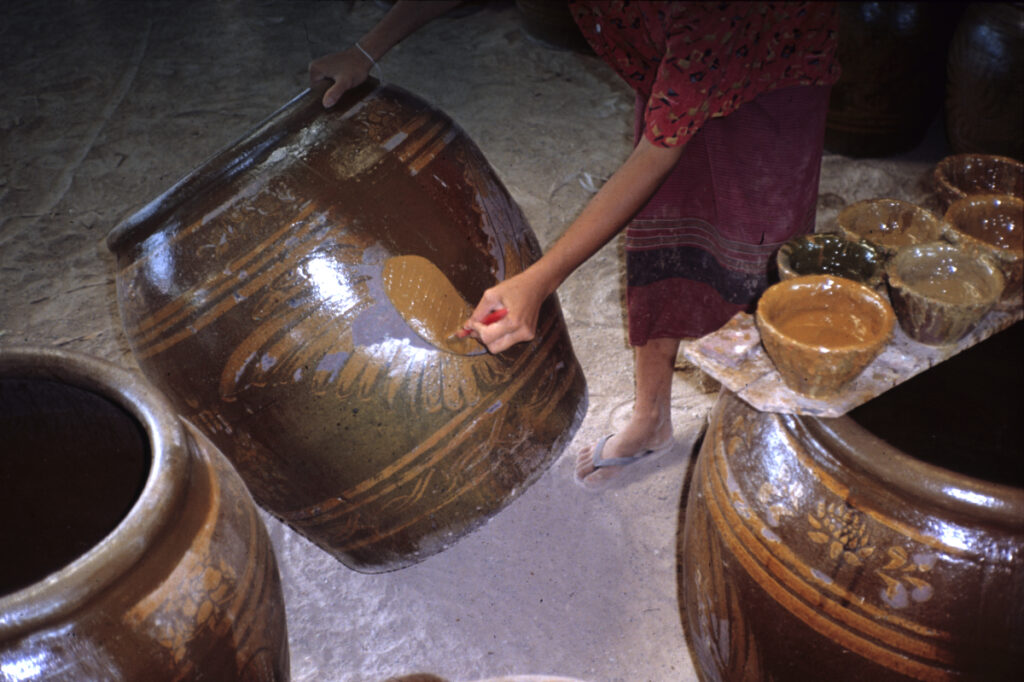
Ratchaburi Jar being painted (1989)
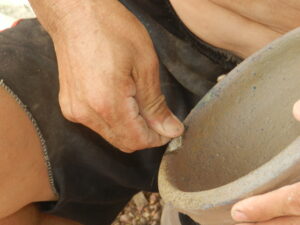
Cosmetic repair in Phon Bok
Just Repair: This is just a repair. No, or little consideration is made concerning the repair. It is just repaired. Nothing is covered up or concealed. This is the kind of repair that is held in high regard by Soetsu Yanagi when discussing Korean wooden bowls. It has a stance of honesty, of thusness, it is what it is. The bowls are turned from green wood. When they crack, they are repaired. This is what my brother did. He repaired his bumper with available cable ties. No cover up, no intent to do anything but make it functional.
Intentious Repair: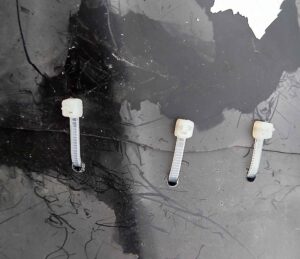
Bumper fascia repaired with cable ties (photo credit Ralph Katz)
This is a Just Repair specifically made with the intent of looking like a just repair. Pretentiously, rather than just making the repair, the intent is to make it look like you did not care about appearances. You not only might not care, you want others to know that you don’t. Louis does these. The picture of a bumper posted to the web by a sophisticated artist, even if the art is music, makes me wonder if Ralph’s qualifies as intentious. I have not asked. Either way it has sparked my interest. I have appreciated it. The bumper, at least in my mind is interesting. Appreciated it enriches life. Appreciation appreciates the value of an object or event.
I have shirts that I bought in 1989 in Thailand. In Thai the name of the shirts seems to be “humble shirts”. I wore mine every wash until they got fairly worn. Others would say “worn out”, but I prefer “broken in”. After that I wore them on non-school days. My personal feeling is that these shirts still have use with a little repair, and that long use is as functional, maybe more functional than recycling. So I have repaired these shirts. They are repaired rather funkily, wow spell check has “funkily”! The repairs are so obvious and perhaps overdone that they might go beyond intentious into the next category, The Conspicuous Elevation of Repair Repair.
Conspicuous Elevated Repair, Kintsugi.
Kintsugi is a Japanese repair technique often used on ceramics using urishi lacquer, a natural resin. It is water proof and holds up to mild heat. The repair resin, made from the sap of the urishi tree, is sometimes filled with iron oxide, but the upper layers are often instead filled or surfaced with gold powder. This makes the repair, a record of the objects history and its breaking, obvious. It makes the damage obvious, making it impossible to ignore. It holds, displays, asserts that use becomes tangible part of an object. In highlighting use and wear it elevated repair seems to demand that bowls are drunk from and not just displayed that you know it and that you remember.
Rather than coverup, rather than mourning the inevitable, kitsugi is an affirmative joyful appreciation of the mutual arising of creation and destruction, afe, wear and tear, and eventual breaking of ceramics. The atmospheric firing of ceramics leaves a trace of its time in the kiln, the repair is just another page in the history of the work. Art is often made in a way the reveals the process of making. With tea ware in Japan there is recognition that who has drunk tea from a bowl, how it is stored, and in what manner it is handled becomes a part of the work. So does the wear and repair. Raku, a firing technique, and shino, a type of glaze both leave a surface with a fine network of cracks. This allows tea to stain the cracks and sometimes the clay body, overtime changing the appearance and making it appear worn before there really is any wear.
While most of the Japanese aesthetics surrounding tea ware stresses a quiet understated natural feel, Kintsugi seems almost diametrically opposed to this. . The contrast creates a sense of importance of the issues surrounding the repair .The gold, bright, valuable, associated with the aristocracy, seems wildly antithetical to the humble nature works that are repaired. On its visual soapbox, kitsugi loudly speaks, “I am a repair” . It is an unassailable statement affirming use and wear as an aspect of an object and aesthetics. If you don’t understand this, the gold slaps you in the face with the message.
(Look up boro repair and shashiko Japanese clothing repair)
But all of these repair techniques, and their associated intent are in some ways the same. Each tells a story, each leaves an impression of intent, or lack of it. Each expresses an attitude on the topic of mutual arising. Each tells of human nature. The difference is in the way we perceive and the way we appreciate them, and in our understanding of the intent of the person who repaired it. The difference, for the most part resides in the viewer. It is the viewer that appreciates, the creates the great value of the repair.
Non Repair repair
This is repair after intentionally breaking an object, or making an object specifically to look as if it is repaired. Goro Suzuki, whose work is purposefully broken is the master of the Non Repair repair. He intentionally breaks pieces to repair them, and really builds his work with kintsugi type repair techniques. For him it does not need to be broken to repair it. Its like he is saying, “If its not broken fix it anyways.” I am not sure that there is anything as conspicuous as this kind of “repair”. The fact that it is not broken screams for its own category . The function of the Non Repair repair is often to teach appreciation of repair.
The place where repair has become more a part of the aesthetic culture than elsewhere is Japan. But modern Japan is quite a throw away society. Houses get too old, cars get too old, clothes have to look new and respectable, hair is always highly tamed. But in this atmosphere kintsugi and the boro technique and shashiko clothing repair seem a response to this, a cultural self criticism. Not being Japanese it is hard to know.
The appreciation of the worn, the repaired, the aged, the imperfect, while it seems far from modern Japanese day to day life, is part of the cultural aesthetic. But it also appears elsewhere. New blue jeans in the US can almost be embarassing in youth culture. This is so true that new jeans are often bleached, stone washed and intentionally distressed in other ways before being sold. Some of the coolest “hippy” clothing were blue jean skirts sewn out of multiple pairs of worn out blue jean pants.
I often think of a bunch of poles or nodes pulling at the creation of worn jeans. - The Pragmatism Node and being a cheapskate. This is also tied to just being poor and not being able to afford or wanting to afford new cloths. Likely need and want could be separated out into separate nodes. There is overlap here with other nodes.
- Appreciation of the look, the Wabi connoisseur.
- Marketability, the Stone Washed Node
- concern for the environmental impact of cotton and consumerism, the Green Node
- the Clueless Node. This is the node of people for whom the buying of new clothes is just a distraction from the rest of their lives, they don’t notice.
These nodes are just like little elastic straps that pull on how we deal with our jeans or other objects. My old denim-type clothing is clearly elastically attached to each of these nodes.
Certainly I am not the first in my interest in such things. But the earliest serious interest, and just about the only significant historical cultural manifestation that I know about was the period surround what Louise Cort calls “The Teabowl Wars” and the moves in Japan from the aesthetic of glitzy teaware to wabi and move from connoisseurship of folk pottery to the purposefully making of wabi imbued wares.
Relation to teaware’s shift from being curated from folk pots to purposefully made to be “funky”
WhatsInaCup
What is in a cup? [still writing]
An essay about a single cup,stoneware, a touchstone, vessel, works with coffee, tea, jelly beans.
I have been using a cup that I made in Thailand since 1988. This is an essay about the areas in my life it touchs, the thoughts that are tangent to its exterior, its place in my life.
I suppose that this starts in about 1972 when I first signed up for ceramics classes in High School.
I walked into school as 11th grade was about to start and got in a line. At the head of the line I was given my schedule. I had selected classes as the previous year was ending. These included Electronics, Choir, Trigonometry, I am not sure what else. I was given the schedule and looked at it. I told the teacher behind the desk, ” I can’t take this Trigonometry class”. We went back and forth with him telling me that he could not change it, getting mad when I insisted. Then I let him know that the teacher was my mother. He said, Come back here, lets see what we can do. I remember that the schedule after changing the Trigonometry class was really limited. I needed a different class for 7th hour. I tried Metals shop, Drafting, Hebrew language, Physics, Photo, probably others. There was something left called Ceramics. I think that I had to ask what it was. That is how I got started.
We did some American Raku firing during the class. When you do this you get surfaces that are outside your direct control. They have an air of naturalness at times. By this time in the semester I was reading books about ceramics every week, lots of books. A few were about this technique, Raku.
Raku, at least in some ways, revolved around a Japanese aesthetic principal, wabi. Wabi describes an appreciation of the worn, the old, the imperfect, in some ways just nature. While I have been told that it is Zen in origin, I think the real origin is closer to Taoism. In my first year in college I took a course from Dr. Walter Spink who described a person who was perfectly in tune with the Tao, the nature of nature. This person walked down to the bridge over the raging flood in a rocky mountain stream, disrobed waited a few seconds and jumped in. Perfectly in tune with the Tao, he washed up a bit down stream perfectly clean and walked back up to get his clothes. He understood the way, the way of the world, and without much effort could chose just the time and place to jump in and get washed out. Images of streams and rocks are seen as symbolic of The Tao. The ideas and practice of Taoism predate the Buddhism and particularly Zen by many centuries. However, Wabi is attached with Zen. I am not an expert in either, nor a practitioner.
Raku is really the granted title of a person who made teabowls. It then named the process and style of their making. The title is hereditary. The current holder is Raku Kichizaemon XVI. I met Raku XV at The Archie Bray Foundation. I found it not that remarkable a time except that I found it ironic that the slide projector we were using for his slide show caught fire.
Making work in this genre that really does it for me is difficult. The skill and sensitivity is something I cannot quite grasp. Excellence always involves the intangible, but for teabowls it often seems further from my grasp. I really started to appreciate the aesthetic early and in high school built a wood burning raku kiln in my backyard.
I ended up in undergraduate school in Kansas City, Missouri at The Kansas City Art Institute. The department head there, Ken Ferguson, was enthralled by Wabi Sabi. The museum next door, The Nelson Atkins museum always had a few pieces of Japanese teaware on display. Between Fergusons interest, the pots at the Nelson and the general tone of American Studio Pottery at the time we were all sucked into the aesthetic.
In the 1970’s there was a strong “back to nature” cultural push. The organic foods movement got a big boost. Gas crises helped create a low energy mindset. Home grown and home made, local production and consumption all had strong cultural support. Natural looking fired surfaces were a rage, and in some ways still are.
A group of potters associated with the late Warren Mackenzie who was an apprentice of Bernard Leach taught at Minnesota State University and a group of potters gathered in the area. Many of them were dedicated to natural surfaces in their work and used the kiln as the creative instrument to make the surfaces. They fired with techniques now know as “atmospheric firing techniques” but not raku. Raku makes good ceremonial ware, but is not a good choice for daily use. The techniques used were wood firing, salt firing, a kind of firing called residual salt, and an offshoot of salt firing, soda firing. These techniques were used at high temperatures with non-porcelaineous clays to give the works rough natural surfaces.
Bernard Leach worked in Japan with a potter Shoji Hamada. Along with Soetsu Yanagi they were interested in what has been translated often as Folk Craft or in Japanese, Mingei. In school, Ken Ferguson was standing behind Gail and said, “I wonder how you could combine Mingei with Minnesota. Concentrating on something else Gail said, “Minegeisota”. Clearly already having this word at hand but now having someone else to blame for it Ferguson tried to use it as a putdown to these potters. Instead of it being a putdown, they embraced it. What had been known as the Warren Mackenzie style or school of pottery making became known as The Mingeisota School.
Prior to these names, atmospheric firing, Mingeisota, or knowing the phrase Wabi Sabi, I was already enthralled. I preferred wearing jeans until thread bare. The same is true of shirts. The use, the wear, the rips, all tell a story. The story “new” tells is a false cloak of respectability. Respectable cloths do not impact the respectability of those wearing them. You are how you look is only an “ism” an illness of an imperfect society whose focus is on trivialities rather than realities.
But when Yanagi, Hamada and Leach talked about Mingei, they were talking about ceramics outside of schools, outside of galleries, indigeneous, humble. I do not think that they were even at the beginning talking about what they made, it was too expensive. They were talking local production for local use.
Repair rather than replace is either the mark of people without much cash, or a sign of someone who values the natural of materials, the work of hands, the environment, or economy. People like this have values. New clothing is an affectation. I find it hard to label its draw to some as a value.
The affectation of the worship of the new, is in some a desire to show that they earn money. This desire is understandable as our language continually mixes up values and value or qualities with quantities. I am reminded of Lung Gaeow, an old friend in Thailand with little money or possession but a great human full of humor, compassion, and hard work.
While in school in Kansas City we were given an opportunity to order books from Kodansha Publishing on kilns in Japan and their wares. There was one book for each pottery village, sometimes two different ones. These books was about 18 inches by 12 inches with huge high quality color photographs and cost less than $5 each. A Japanese student, Akio Takamori who the community sorely misses, picked up the books and shipped them. These books introduced us to Japanese potteries, “The Six Ancient Kilns” and many others were included in these series of about 50 books. I fell in love with Bizen and Shigaraki, although there were countless others it seemed that also held my interest.
Bizenyaki, the Bizen potteries, fire much of their work to just the temperature that the clay starts to be vitrious, but can still maintain the orange color if protected from the flame and ash. How the kilns are stacked in Bizen became the primary decorative technique leaving some areas orange, some brown. Stacking with rice straw left markings from the alkali metals in the straw.
In graduate school a fellow student, from Thailand showed me slide images of a pottery in NE Thailand called Dankwian. The pots were almost exclusviely 20 gallon water storage jars, wood fired, no glaze, fired to about cone 7, a lot like Bizen pots. But these had never been snarfed up as teaware. They were intended for humble use. Most pots like this were long gone in Japan.
The graduate student, now retired Professor Poonarat Pichayapaiboon, and I took courses together. His English was spotty so as I helped him with English he taught me a bit of Thai. A few years after graduate school I heard that there was a Thai potter visiting the Archie Bray Foundation. I walked up, and in Thai said, “Hello! Where is the bathroom”. She pointed. I then asked what I though meant, ” Do you know of the village of Dankwian?” Not really meaning that she responded in English “What do you mean?”. Turns out she owned a pottery there. This is what prompted the Thai Fulbright.
Glass ลุงแก้ว
Written prior to Uncle Glass’s death in 2026. He will be missed by all who knew him.
พอเพียง Paw Pieng translates as “enough”, or “sufficient”. It is one of the mottos and goals for the Thai People put forward by Rama IX, HRH King Bhumipol The Great. When he came to power there was a great deal of poverty and he wanted development projects that would provide enough for the people. His plan calls for reasonableness (or wisdom), moderation, and prudence. He said that the underlying conditions for this must be knowledge and moderation. Over the years before and during his reign its often been clear that there must be an economy of self sufficiency, that the country should be able to live without the outside world, be able to shield itself from the valleys of the world economy. In my mind I have decided that the word “sufficiency” is a better translation of this idea than “self sufficiency” because it stresses “enough”. Learning a little about this philosphy gave a new context for an old friend of mine, one of my personal heros, ลุงแก้ว Uncle Glass .
Uncle Glass is a very funny, joyous man. He is fast to smile, crack a joke, pull your leg, and smile again. He is not “well educated” but is very smart, and it would be mistake to underestimate him. He has a bad leg. I do not remember how his leg was hurt, his calf broken, but it was when he was a young man, maybe in his teens. He was put into a cart and taken to the doctors. The doctor said that his leg below the break would need to be amputated. The monks from the local Buddhist temple said that they could heal the leg. They took care of him, bathed him, changed his clothes, and fed him. I was told how long this healing took, but I remember only that it was most of a year. Lung Gaeow (Uncle Glass) can walk, but for most of his life he found a bicycle a better mode of travel at least for distances more than about 20 meters.
Until he retired, Uncle Glass lived in what in the US we might call “a shack”. It had a tin roof over the old one made of leaves or grass and short posts, and a wood floor. The walls did not protect from the wind much. His first wife got ill and he cared for her until she died. He remarried someone that he knew from school. I think he was in his fifties when this took place. She developed diabetes and became bed ridden. He cared for her until she died. His third wife he married only so that the village would not talk. She was already in bad shape and he could not care for her without there being gossip unless they were married. She was still alive in 2008 if my memory is correct. The world could use more people like him. He is a mensch, a great human.
When I visited him back then (2014) he was going to the river every morning on his bicycle, maybe about a 1 km ride. He would park and climb down the banks. At the river he set some hooks with bait and then wash. He carried water up the bank (maybe 20 feet down) and watered his garden. After several loads he would pull out the fishing gear. When I was there he caught about 5 skinny 4 inch fish. Up on the bank he put them directly on some leaves he set on fire. Then he sat down, got out some glutinous rice and spicy vegetables, and a shot or two of whiskey his son in law packed for him. The fish, now cooked dry, were packed in paper and he rode is his bike off to the pottery to make water jars. A good person helps people in need. A great person does this again and again. I had hoped to make a video about him, but I started just as his physical productivity was failing from age. As I write this he is still a joy to be around.
Lung Gaeow appears in my Thai Pottery Video in the height contest( https://www.youtube.com/watch?v=zi_t0y5jFxM&t=409s 02:57 ). After I returned to the US I was asked to write for grants to bring Thai potters to The National Council on Education for the Ceramic Arts Conference in 1991 in Tempe Arizona. Suwanee was to deal with all the arrangements in Thailand. I first asked for Uncle Good. I thought that he was nice, and had a love for making pots. He had a nice way with the traditional forms. He decided that he could not come because he was afraid that we would not have rice in the US and he could not eat bread. The word “eat” in Thai is really “eat rice”. The bread they sold in his part of Thailand was used as a desert dish, sort of like ultra-sweet Wonder®-type bread. The second person on our list had no birth certificate so they could not get a passport. Suwanee asked around. Finally two men agreed to come, “Craftsman Shotglass” (Chang Jork), and “Uncle Glass” (Lung Gaeow).
Lung Gaeow and Chang Jork (now deceseased) had a problem with alcohol. They were not anyone’s first choice but they were brave enough to come. Had I known more Glass would have been first on the list. My sole job at the conference was to take care of the 5 Thais, Suwanee (who could take care of herself) her sister (who stuck close to Suwanee), Mae (mom), and Chang Jork and Lung Gaeow. My Thai was rotten back then, but things worked out. So the morning after they arrived I went to see them. Gaeow says, “Louis, great to see you!” We are talking,,, how was the flight etc. “Louis, the flight was very nice but the airplane was cold, they brought us blankets.” “And you know Louis, they do have alcohol on the plane, I was worried. But it is so expensive and bottles are so little. Is it that expensive everywhere in America?”. I said, “no” .”You know Louis, we have alcoholism. Could you take us to buy some?”
So, I took them to the local alcohol store about a mile from their apartment. They walked in behind me. Gaeow grabs my arm kind of hard, it hurt a bit, “Louis, (he swings his arm to point across the store) Is all of this alcohol?” I answered, “No, that case over there is soda and Coke”. He said, “Louis, America is a great country!”.
He said, “Which type should be buy?” We finally settled on cheap beer. I picked up a six pack. They picked up two each. I showed them how to pay for it and we took it back to the apartment.
A couple of days later I stopped at the apartment. “Louis, we need more beer.” So we went back and got more. Gaeow told me that Jork could not read. Jork said,”Gaeow can’t read”, show us how to do this, then we won’t have to bother you.”
A few days went by. I was looking for them. They were not at the studio, not at Kurt Weiser’s house and not at the apartment. Then it dawned on me, “They are at the liquor store”. So I drove over to get them.
I walked in and they were not there. I turned to ask the cashier. He recognized me, “Its you!Where are those to guy’s from?” “Thailand”. “What language do they speak?” I answered “Thai” although really talking with each other its the local dialect. The cashier asked, ” Do you know what they did?” I am half already amused and a bit fearful.
“The rolled a big cigar with newspaper and a bunch of tobacco I think. The do smoke tobacco right?” I nod. ” You know, you can’t smoke in here” . I said that I would tell them. “After they lit that cigar, they squated in the back of the store in that language, What language did you say that was?” “Thai”. “Yeah, thats it. After a few minutes they came up to the counter, put thier hands on it and said, “Alcoholism, Alcoholism”. “I sold them some cheap whiskey. “You might want to tell them that they can’t drink in the store”. I thanked the cashier. As I was leaving he said, ” tell them the should not drink on the street either”.
So I head back to the apartment. “Louis!” Gaeow says,” I guess you were looking for us” . I said, “yes”. “Did you go to the liquor store?”Gaeow looks at Jork. “Yes” I said.
“I guess that the clerk said to tell us not to smoke in the store” I said, “Yes, it might explode”. “And we’re not supposed to drink in the store either?” “yes”. “Why not?” . “They don’t want drunk people in the liquor store”. Gaeow says something like, “how do they expect to make any money”. I tell them not to drink on the street. “They ask, “If we do, how much do we pay the police?” I explain that it is probably a mistake to try and buy off the police.
Chang Jork stopped by at Umdang Pottery when I was there in the early 2000’s. He gave me his Saw Duang ซอด้วง. This gift was probably the most significant of my life. He was not long on possessions. This was a return gift for bringing him to the US. He died a few years later.
I tried to see Lung Gaeow nearly every time I went to Thailand. He is my elder. If I was to visit him I needed to bring a gift. Normally this would be fruit, but he is an alcoholic so whiskey is what is expected. I no longer bring a full bottle.
Anyhow, I went to visit him about 15 years after his trip and he said, “Louis, Thanks for the whiskey. The neighbors don’t believe I ever was in America. Do you have any pictures of me there? And can you bring them here tomorrow?
I did not really understand this request until I stopped for another bottle of whiskey on the way the next day.
I saw Lung Kaeow last in January 2026. He was nearly completely blind. He was still smiling and laughing. I recently learned that some called in “Kaeow America”. He died April 18, 2026 . There are a few great people whose being seems to stick really hard to mine. He is one. He was one of the poorest great people I have met and also one of the funniest people I have met. His life enriched those around him with laughter and humanity. He will be missed by all who knew him.