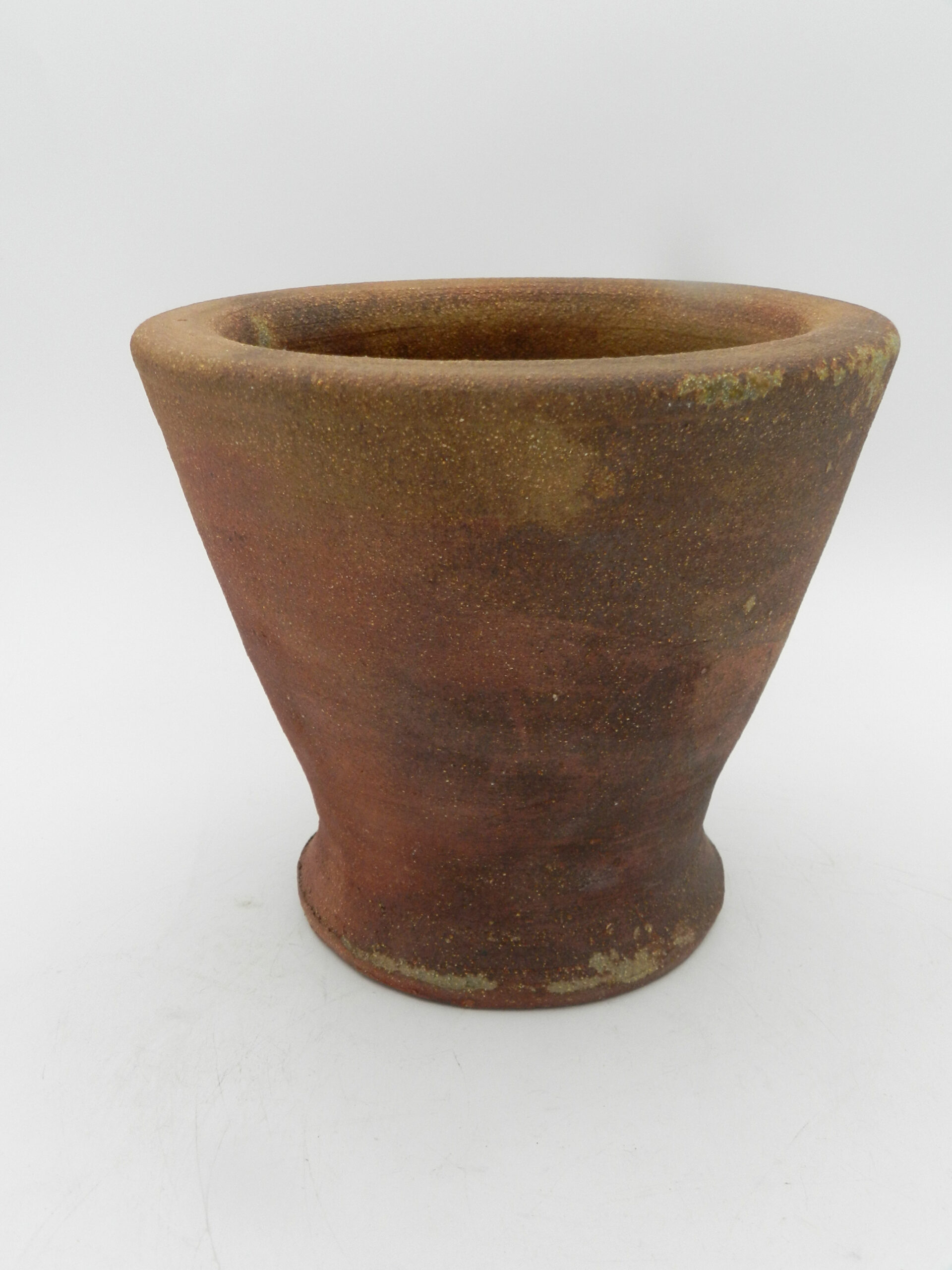
Where do ideas like The square potter’s wheel, and a Flame throwing pipe organ come from. An Outline for a talk at NCECA 2027. This should be considered a work in progress rather than anything finished.
An understanding of undergraduate critiques of the minimalist sculpture type known a s functional pottery.
What parts of the design have not been considered? Or what parts look as if they have not been considered.
New ideas, innovation happens in the same space, the space not yet considered. In our minds it is easy to segment the realms of ideas not yet considered but in some sense they are all the same. Lets go through some of them.
Tools not yet considered as appropriate for the use you will use them for. Examples
Sand Blaster used by Kurt Weiser
Air Chisel on glass by Janusz Walentynowicz
CinvaRam Brick Press by Louis Katz
Unusual hand tools. Student Exercise.
Materials discarded as impractical or not yet considered for the use you put them to.
Portland Cement glazes
Calcium Chloride for surface decoration
Gerstley Borate as clay ingredient to promote scumming
Chunky Copper wire Oxide
Corn
Sewage Treatment Plant Ash
Discarded sludge from granite countertop cutting.
USe of Cobalt Oxide as a flux. (Ceramic MAterials Workshop)
Use of Manganese Dioxide as a flux (Baslat Ware Wedgewood)
Techniques that won’t work.
Clay on welded wire fencing
Slipcast Glass
Difficult forms
Glaze faults
Sperry platters
Crawled Shino
My student’s teapot
Absurd Amalgams.
Cutting molds with saws rather than making separate pieces. Who is the person doing this today? Is this really just a different tool application?
Urban Teapots
Is this new? Shang Dynasty Bronzes.
New ways to do old things.
Walk around the pot rather than spin the pot. THis is really an old way to do it.
Make Chrome thin Pinks with Zinc (Ceramic Materials Workshop research)
Inbetweens happen between words and concepts. There is no hard like between blue and green yet we treat them as if they are distinct. Many of the most interesting colors occur in the area where these colors approach these verbal distinctions. People that think as if colors are distinct live outside of subtle use.
But the line between function and non function is a similar line. Something pleasurable to look at serves a function. In my Uncle Bernie’s verbiage, designed to poke fun at contemporary abstract sculpture, sculpture modulates space. Paintings act as decorations for walls. The function of art is as objects of contemplation, avenues for expression. It is this line, and how we define it in Ceramics, that was the first place where I see idea as the realm where I started to innovate. What is function? What functions are we forgetting about? What do we mean by it.
What is Ceramics? Most will tell you its a class of materials. But even then it depends on who you ask. A chemist will tell you “Metal Oxides”, an engineer will tell you materials to hold or withstand high heat, an NCECAist might tell. you clay and glazes. Glass they might see as a grey area?
Me? I sufferer from Meglomania Ceramica, I claim it all, graphite, granite, portland cement, glass, silica gels, and yes clay.
But Ceramics is also a way or group of ways of looking at design, ways of working, a history or historys.
You, You are Ceramics. Ceramics is a community or maybe communities. I call members of this community Clayers,
How you look at Ceramics influences how you see what you can call ceramics. How you define function limits what you call functional Ceramics. Even people who are serious about making functional pottery understand this. Mark Hewitts titling a jar “umbrella holders” is a clear sign of this.
As an exercise, perhaps in absurdity, but certainly as a way to grow, to come to grips with the illusional order word definitions inflict on the world, I inflate definitions until they encompass as much of reality as I can muster. I truly am tired of the hierarchy in the arts. I refer to painting as ceramic and other pigments stuck in place by a binder. This converts those cave paintings in Lascaux and elsewhere from the craft of painting to the Art of Ceramics. The cave walls, rock, are ceramics too. Lets make sure that the art historians get their terminology straight. Shall we?
Better get to the wheel. What parts of the wheel to we just accept and live with? The stable axis. Some of us do understand that steady speed is not so necessary, that is if we throw for long on a Leach Wheel or make big things on a kick wheel. Steady speed is not needed but spinning on a stable axis never gets questioned.
Kurt